Systems Thinking, Geospatial Science and the Complex Nature of the Sustainable Development Goals

Intellectual Property of mohammed

I sat in on a panel discussion at the AAG conference (Las Vegas, 2009) between the US State Department, Jack Dangermond from esri and a number of international organisations.  The subject was “Continuing Global Dialogues on Geospatial Science and Sustainable Development”.  Again, the aspiration for unified sustainable development goals was evident.  What was also clear was the level of complexity of such goals and the intricate role systems thinking and geospatial science would play in achieving them. 

The eight UN Millennium Development Goals were replaced 7 years later by 17 Sustainable Development Goals [1].  However, to date the achievement of these goals remains a challenge, whether it is due to systemic barriers [2] or issues around prioritisation and accountability [3].  In addition, I argue that a holistic view of and complex systems approach to these 17 goals are predominantly absent and contribute significantly to these deficiencies.  Considering the familiar image of the Sustainable Development Goals (Figure 1), it is hard not to envisage a list of subjects to be addressed through a reductionist approach:  decomposing these goals into 17 or more pieces, solving them separately and putting them back together as a consolidated solution. 

Figure 1: United Nations Sustainable Development Goals

However, such an approach ultimately overlooks the complex interrelated nature of these 17 goals – multiple causes and effects between them, feedback loops and autonomous actors.  A systems thinking approach would allow for the relationships between these goals to be identified and also prioritised in terms of importance.  Hence, the consideration of network theory (link analysis potentially) would optimise prioritisation. Furthermore, the influence related goals have on each other will reveal leverage points to guide attention and decision-making.  How would Goal 1 (No Poverty) be achieved without consideration of Goal 3 (Good Health and Well-being) or Goal 4 (Quality Education)[4]?  How do different goals compete?  How will ecological sustainability and inequality reduction potentially be influenced by the aspiration of a high level of economic growth?  These goals should thus be viewed in a different manner.  Figure 2 provides one of many examples, showing the relationship between goals and the level of significance [5].  Fu et al. (2019)[6] regarded sustainable development as a societal outcome, produced through the assurance of a balance between human development and environmental protection, and in doing so revealing that goal implementation is an optimisation process within a complex global system.  

Figure 2: SDG Network Analysis (Jeff Mohr  @kumupowered)

The application of Geospatial Science in studying complex geographical systems offers far more than merely the analysis and visualisation of static or even basic temporal geographic dynamics. Increasing convergence of spatial data science and methodologies for studying complex systems enhances the possibility of considering and understanding better the interrelated and non-linear dynamics of phenomena.  This is particularly important, given the eye-watering 169 targets set out for the 17 SDGs.  Advancement in techniques for the incorporation of GIS data into agent-based modelling and cellular automata toolkits resulted in a significant increase in spatially explicit modelling. 

Furthermore, the benefits of GIS and BIM (Building Information Modelling) integration extend far beyond the optimisation of sustainable designs, assurance of collaborative workflows and efficient life cycle management of infrastructure (promoting Goals 9 and 11).  Combining BIM and GIS not only optimises the assessment of urban energy performance in smart city planning [7] for example, but also aids sustainable management of the complex relationship between the built and natural environment.  The practice of GeoDesign applies systems thinking to the collaborative consideration of complex environmental dynamics and subsequent enhancement of sustainable design.  The IGC (International GeoDesign Collaboration) adopted the SDGs as a standard format for assessing the impacts of more than 2 000 scenario-based designs [8].  Hence, all IGC projects should indicate how efficiently design scenario outcomes would address the SDGs.

The intention of this discussion is to promote systems thinking in terms of the SDGs and the consideration of these goals and related targets as interrelated components of a complex system. Thus, a broad overview is provided of subjects for deliberation, rather than an in-depth study of each.

References

[1]  https://sdgs.un.org/

[2]  https://europa.eu/capacity4dev/articles/challenges-implementing-sustainable-development-goals-asia

[3]  https://borgenproject.org/three-challenges-of-the-sustainable-development-goals/

[4]  https://unsdg.un.org/blog/untangling-complexity-sustainable-development-goals-moldova

[5]  https://blog.kumu.io/a-toolkit-for-mapping-relationships-among-the-sustainable-development-goals-sdgs-a21b76d4dda0

[6]  https://academic.oup.com/nsr/article/6/3/386/5381567

[7]  https://www.sciencedirect.com/science/article/pii/S1877705817318167

[8]  https://www.igc-geodesign.org/project-workflow

The Evolution of GIS

1832-new-map
Copyright:  Geocom Ltd.

While celebrating the 50th anniversary of Earth Day, it is virtually impossible not to consider the contribution of geographic information systems and science in studying and solving complex problems in Earth Sciences.  Given the fact that the first mention of a “geographic information system” occurred only 8 years before the first Earth Day celebration, in a paper by Roger Tomlinson, I decided to revisit the evolution of GIS over half a century.  The following is by no means a comprehensive discussion on the history of GIS, but rather a summary of what I personally deem as evolutionary highlights over time.

1960’s – The Field and a System

roger
Roger Tomlinson.  Copyright:  Esri Canada

  • As computers developed and the earliest concepts of quantitative and computational geography emerged, the field of geographic information systems (GIS) originated.
  • In 1963, Roger Tomlinson was commissioned by the Canadian government to create a natural resource inventory that can easily be managed. Tomlinson envisaged the use of computers to undertake this task and he designed an automated computing process that became the very first GIS, the Canada Geographic Information System (CGIS)
  • In 1964, Howard Fisher developed one of the first mapping software programmes (SYMAP, see p.2) at Northwestern University
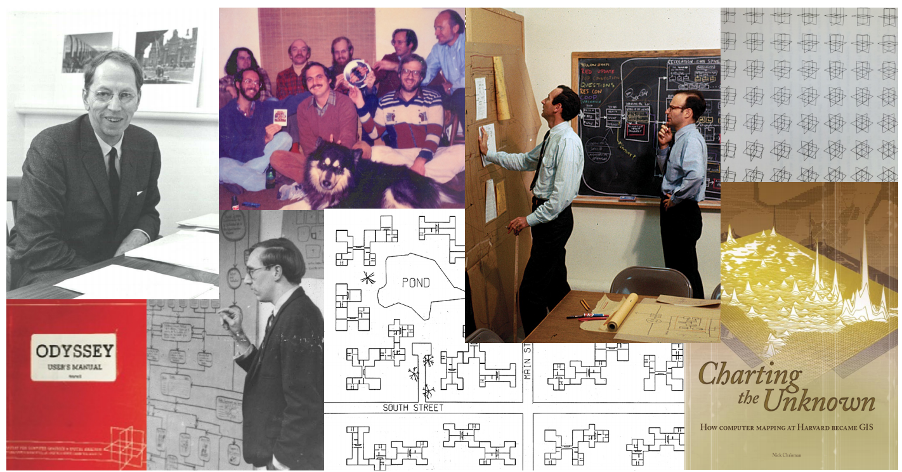
  • In 1965, Fisher established the Harvard Laboratory for Computer Graphics, which not only created the first computer mapping software, but also became the first research centre for spatial analysis and visualisation.
  • In 1966, the Urban and Regional Information Systems Association (URISA) was established by a group of urban planning and information systems professionals and promotes various aspects of GIS to this day
  • In 1969, Jack and Laura Dangermond founded the consulting firm, Environmental Systems Research Institute, Inc. (Esri), which applied computer mapping and spatial analysis to assist land use planners to enhance decision-making

1970’s – Product Development

harvard
Harvard Laboratory for Computer Graphics and Spatial Analysis

  • In 1970, the US Census Bureau produced the first geocoded census by applying a topological model. The topological structure of street segments was coded with ID’s and addresses with X,Y coordinates
  • The Harvard Laboratory developed and distributed (in 1974) the POLYVRT program for the conversion of various data formats, using the topological model that was adopted by the US Geological Survey and Census Bureau
  • In 1977, this work secured a grant from the National Science Foundation and also a symposium for international research scholars, which resulted in the development of the ODYSSEY system (see p.7-8).

1980’s – Going Commercial

Arcinfo
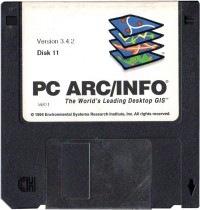
ARC/INFO 3.4.2 (5 disks 3.5″)

  • With the enhancement in computing power, Esri improved software tools and the continuous undertaking of projects to solve real-world problems resulted in the development of robust GIS tools that could be applied more widely
  • Consequently, Esri gained recognition from academia regarding spatial analysis methodologies and the need for tools resulted in the development of the first commercial GIS product, ARC/INFO (ArcInfo)
  • In 1982, this product was released and Esri’s evolution into a software company was initiated
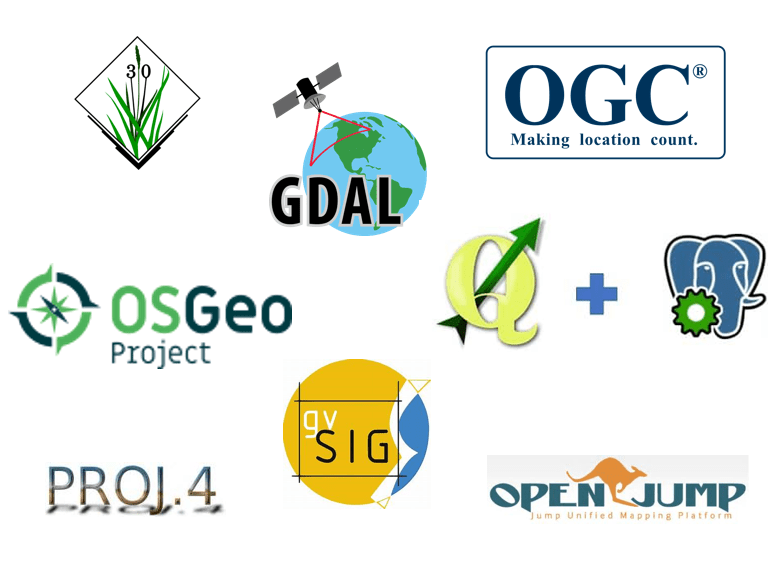
  • In 1984, Geographic Resources Analysis and Support System (GRASS GIS) was released as open source software suite
  • In 1986, development was undertaken of the first MapInfo desktop software
  • In 1987, the UK’s Economic and Social Research Council (ESRC) established four regional research laboratories for four main purposes: data management and provision of spatial data archive, software development, spatial analysis and research training and professional development
  • In the same year the Committee of Inquiry into the Handling of Geographic Information recommended that the British Ordnance Survey should transition to a full digital environment (Waters, 1998)

1990’s – Desktop GIS and a Science

giscience
Copyright:  Joe Dignam

  • Esri released the desktop solution Arcview throughout the 1990’s
  • Further development of the Internet and enhance computing power resulted in a widespread adoption of GIS
  • In 1992, Michael Goodchild made a major contribution to the field of GIS by stating in a publication that the discipline should transition from a systems to a science-orientated position (Goodchild, 1992)
  • Hence, focus should now shift from ‘how to get geographic information into the system’ to ‘how to handle and exploit this data held in the system’
  • Consequently, the discipline of GIScience was born and resulted in the enhancement of spatial data analysis and visualisation tools and techniques

  2000 – Desktop GIS, Open and Online Developments

open


  • In 2002, Gary Sherman started development of the open source Quantum GIS software, now known as QGIS
  • In 2004, OpenStreetMap was founded on the foundation of voluntary GIS, which gained momentum
  • In 2005, Google Maps and Google Earth were launched, providing interactive online mapping and a digital representation of the globe respectively
  • In 2007, Google launched Street View as web application and component of Google Maps and captured more than 10 million miles of imagery across 83 countries in the first 10 years
  • In 2009, Ordnance Survey data became freely available to the public

The last two decade have seen an immense development drive in the field of GIS and the integration of related processes, methodologies, techniques and toolkits.  From Building Information Modelling and Digital Twins to Smart City development and Urban Analytics.  As we embark on this journey to an ultimately digital world, the geographic information system and science will continue to play a substantial role.

smart-GIS1
Copyright:  Urbanizehub

Finally, I believe that the application and integration of GIS with toolkits for modelling dynamical systems (ABM and cellular automata) and generating virtual urban scapes (CityEngine & ArcGIS Urban with Unity or Unreal) will continue to play a pivotal role in sustainability and climate action (the theme of Earth Day 2020).

References:

Goodchild, Michael F. 1992. “Geographical Information Science.” International Journal of Geographical Information Systems, 6(1): 31–45.

Waters, Nigel. 1998. “Geographic Information Systems.” Encyclopedia of Library and Information Science, 63: 98–125.

1000 GIS Applications

StoryMap on Earth Challenge 2020

Digital Twin:  Amaravati

ArcGIS Urban

High-End 3D Visualisation with CityEngine, Unity and Unreal

GIS & Agent-based Modelling:  Urban Growth Model by Andrew Crooks

Enabling Smart Cities and Communities with GIS